

Off the Press! Reporting the Climate: A (Doable) Tip Sheet (1-Introduction)
We're sharing the content of this eBook in six installments over three weeks. This is the first.

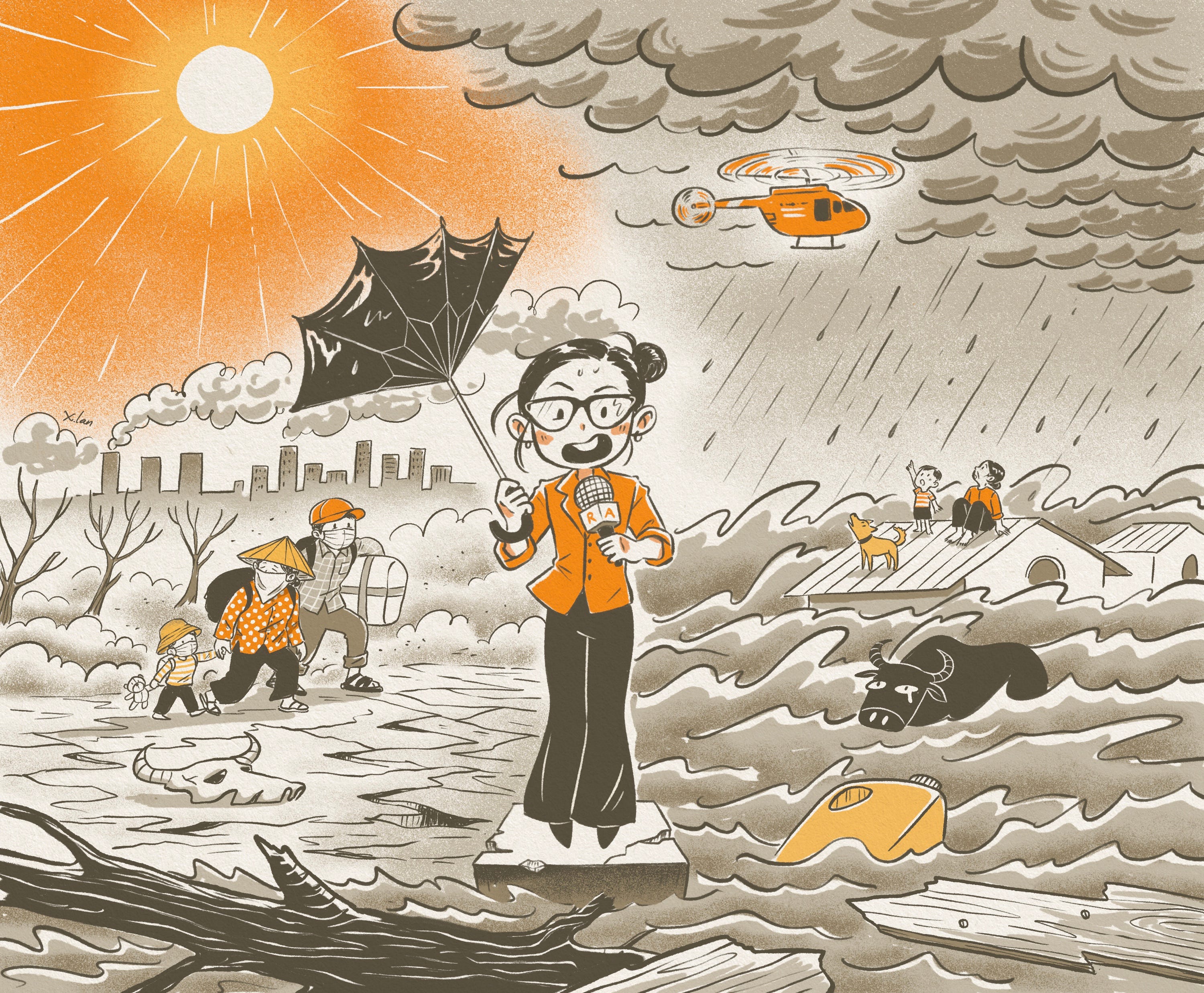
Our latest eBook, another tool for journalism and storytelling, is out! I spent the yearend and new year writing this set of can-dos and to-dos around integrating the climate across the newsroom and across beats, with the realities of Southeast Asia in mind.
The title I thought of for the introduction (which is below) is ‘The Climate is not a Sidebar’.
The US-Israel tandem had not yet attacked Iran when I was working on his 20-page news tool. But when I was looking at the intro title during these weeks (while proofreading the text and reviewing the book’s layout), it felt like a persistent, uncomfortable reminder –of how fossil fuels are the main story that flows through this war with global consequences. It’s not just about the the oil and gas resources. For instance, there is all that carbon that bombardments and explosions are throwing into the already heated atmosphere – on top of the petrodollar context and the US’ coveting of control of the oil resources of West Asian countries that are not its friends. More on these to follow.
But for now, let’s stay with the book. (The second installment will be out on 6 April 2026, and the rest on succeeding Mondays and Thursdays.) The full eBook is here, if you’d like to take a look or read through all of it.).
Till next time from sweltering Bangkok,
Johanna - editor/founder of the Reporting ASEAN series
Part 1 | Introduction: The Climate Crisis is Not A Sidebar
“Uhhh, another climate news tool,” you groan. I would probably have the same reaction – if I didn’t know what Southeast Asian editors said in our survey on how their newsrooms reported on the climate.
In that 2024 survey, which the Reporting ASEAN series carried out under its Sustainability Series, we found out the following:
> For 60% of editors and news managers, the “most doable” option for a newsroom that is building its climate focus is: “train all reporters/producers and editors better in climate proficient and the skill to connect the climate to all areas of news coverage”.
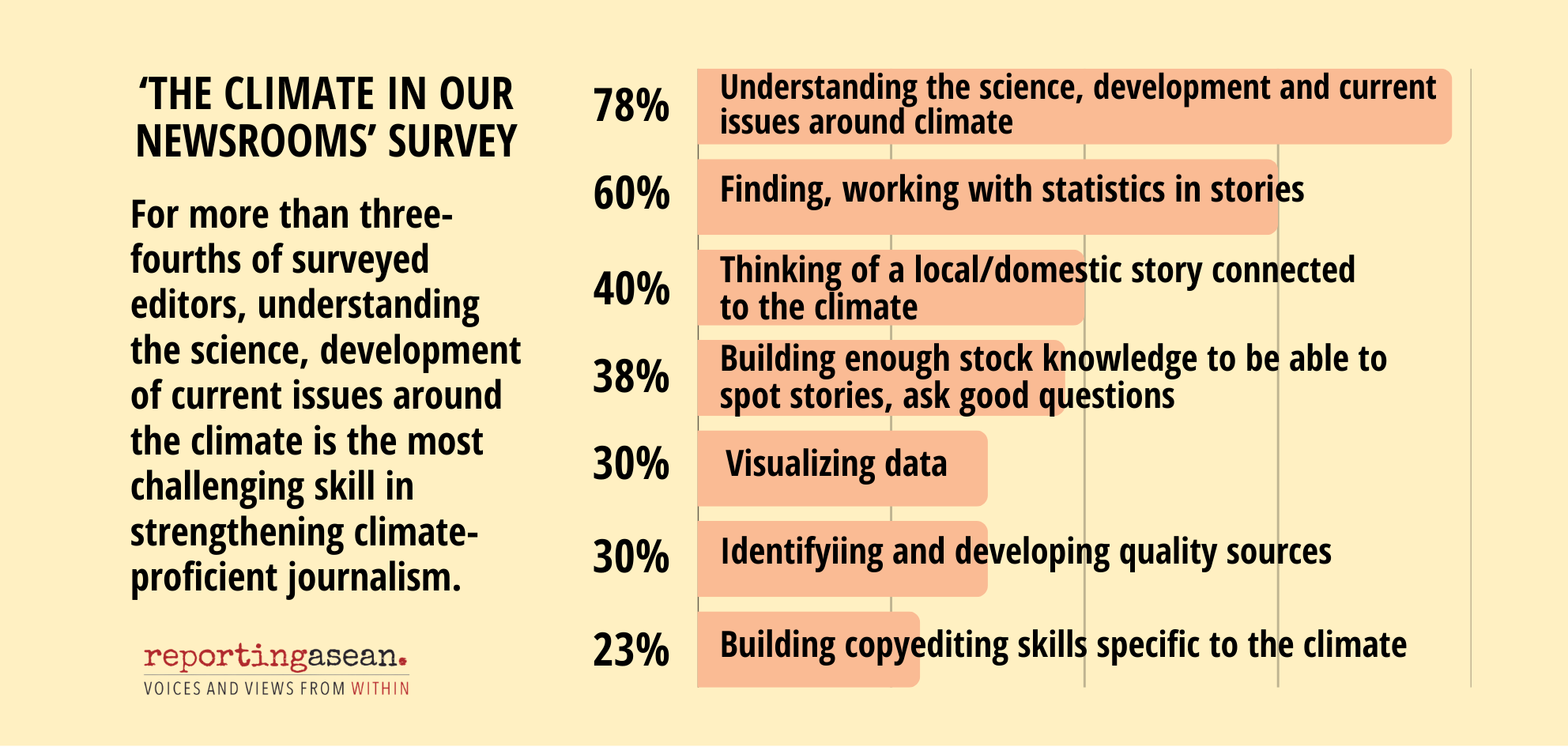
>For 78% of the editors, “understanding the science, development and current issues around climate” is the most challenging skill in climate-skilled reporting.
>60% of news managers said their outlets have not issued guidelines and briefings and/or given training around using a climate lens in stories.
Called ‘The Climate in Our Newsrooms’, the survey was a modest one with 40 respondents, all of them news managers and editors from eight countries – Cambodia, Indonesia, Laos, Malaysia, Myanmar, the Philippines, Thailand and Vietnam. However, the editors’ insights were, and are, illuminating.
A SOUTHEAST ASIAN FEEL
These survey results led to the idea of producing this news tool, one with a Southeast Asian flavour.
Thus, ‘Reporting the Climate: A (Doable) Tool’ is grounded in the media realities of the region, where almost all countries are part of the Global South. What are these realities? First, newsrooms (and newsletters and news projects big or small) do not always have huge teams or budgets. Second, our region is home to coun- tries that have the highest disaster risks in the world.
No one would say that covering the climate is not important. But the point is often around ‘how’ and getting down to the brass tacks of integrating the climate across news work, regardless of a reporter’s news beat or a staffer’s role in the newsroom.
Some editor-respondents in the survey said they worry about lacking in-house expertise to make judgments about storylines or the quality of staff-produced material. Financial issues jump into the minds of some news managers.
But there are many ways to make climate storytelling a whole-of-newsroom, across-all-beats project – or experiment. There is always something we can do, but it all starts with a decision to invest in our capacities, whether as a newsroom or an individual storyteller.
Many options in climate-proficient journalism, explored in this news tool, do not involve huge financial costs. But newsrooms and news teams need to do the work, be it setting editorial direction from the top or learning more about the links between our destabilized climate and the web of life.
We need to spot climate stories through the prism of daily realities, such as what we see in our communities, on our dining tables and in the products we use, instead of filing them by default into the in-tray of the environment/science person or section – or leaving them to the international wire agencies.
WHAT’S IN THIS TOOL
‘Reporting the Climate’ starts with a list of tips and insights to get news profession- als started. Next comes the section for reporters, then the one for managers, edi- tors and copy editors. ‘Useful tools and sources’ shares go-to websites, dashboards and trackers. ‘What’s in a Word?’ looks into terms to update in our climate present. Lots of examples run through this tip sheet.
It also features a number of data visualizations about the climate in Southeast Asia that journalists can explore and use, such as data on extreme events and how audiences view the climate.
We now know that 2025 is the third-hottest year on record. If 2023 and 2024 were marked by extreme heatwaves in Southeast Asia, 2025 brought headlines about storms, extreme rainfall and floods. Scientists tell us that the goal of limiting global warming to 1.5 Celsius, set by the 2015 Paris Agreement, is dead.
The planet continues to overheat amid the worries of the world: anxiety about wars (which add even more to carbon emissions), actions that are destroying global cooperation and undermining quality science, and declining humanitarian/disaster assistance.
The Global South bears the unequal impacts of the climate crisis, as well as the other layers of inequity that this brings. Scientists have identified data gaps that would allow a deeper analysis into what a hotter world means for the communities that need this knowledge the most, pointing out that many climate models have been created mainly for developed nations.
Meantime, two things are true, at the same time. First, this human-induced climate mess is already causing huge amounts of suffering. Second, many solutions, imperfect ones included, are being carried out – and opportunities exist in moving toward a rapid transition away from fossil fuels. Steps like these do not get underway without human action, but they are available.
All of these point to stories for us to tell (including in hopeful reports, which are not any less newsworthy).
The climate crisis is far from just a sidebar in the news, or in our lives. Unlike stories where journalists can pack up and leave, there is no walking away from this one.
More data visualization on various aspects of the climate in Southeast Asia, done by Yvonne T Chua, are here.
(END/Reporting ASEAN)