

Part 2 | Reporting the Climate: A (Doable) Tip Sheet (Starting Points for Journalists and News Managers)
Free climate reportage from the "straitjacket" of the environment and disasters. This is the second of six installments of our latest news tool.


The full eBook can be read here. For Part 1 of this eBook in this newsletter series, click here. Do share this with others :)
Part 2 | Starting Points
Exactly how can journalists integrate climate into news work?
Below are ideas for news professionals, whether managers, editors or reporters, to use as starting points in recalibrating news work or developing climate-proficient and climate-responsive journalism.
1 Free climate-related stories from the straitjacket of the environment and the restrictions of news beats.
The climate is a much wider arc than the environment, although environment issues are among the many realities inside the ambit of climate issues. Climate often gets placed under the environment, but it is really the other way around. The climate is all-encompassing, a system that exists under the thin layer of atmosphere that encircles the Earth (and keeps all of us alive).
Climate stories are like arteries that run through different news beats, just as climate impacts seep into all aspects of our lives. They flow towards issues ranging from economic and human development, chronic illnesses, labour, human rights, gender and inclusion, biodiversity, trade, risk and insurance, corporate planning and sustainability reporting to investors, technology and AI, migration and displacement, research and science, education, architecture, domestic and international law, geopolitics and security, war and peace, sports, arts, books, culture and heritage, and food security and commodities.
This far-from-complete list highlights the point that a climate-related story cannot be locked into one section or beat. Often, the story that straddles topics to connect the warming climate to our experiences is what keeps us engaged and curious.
Whatever their beats, journalists can include the climate in their story radar. For example, a sports journalist can look at how heatwaves are affecting school sports, training regimens, sports records or the timing and location of competitions.
Take a look at how the climate is weaved into the stories – about kimchi, data centres and dengue – in illustration of clippings below.
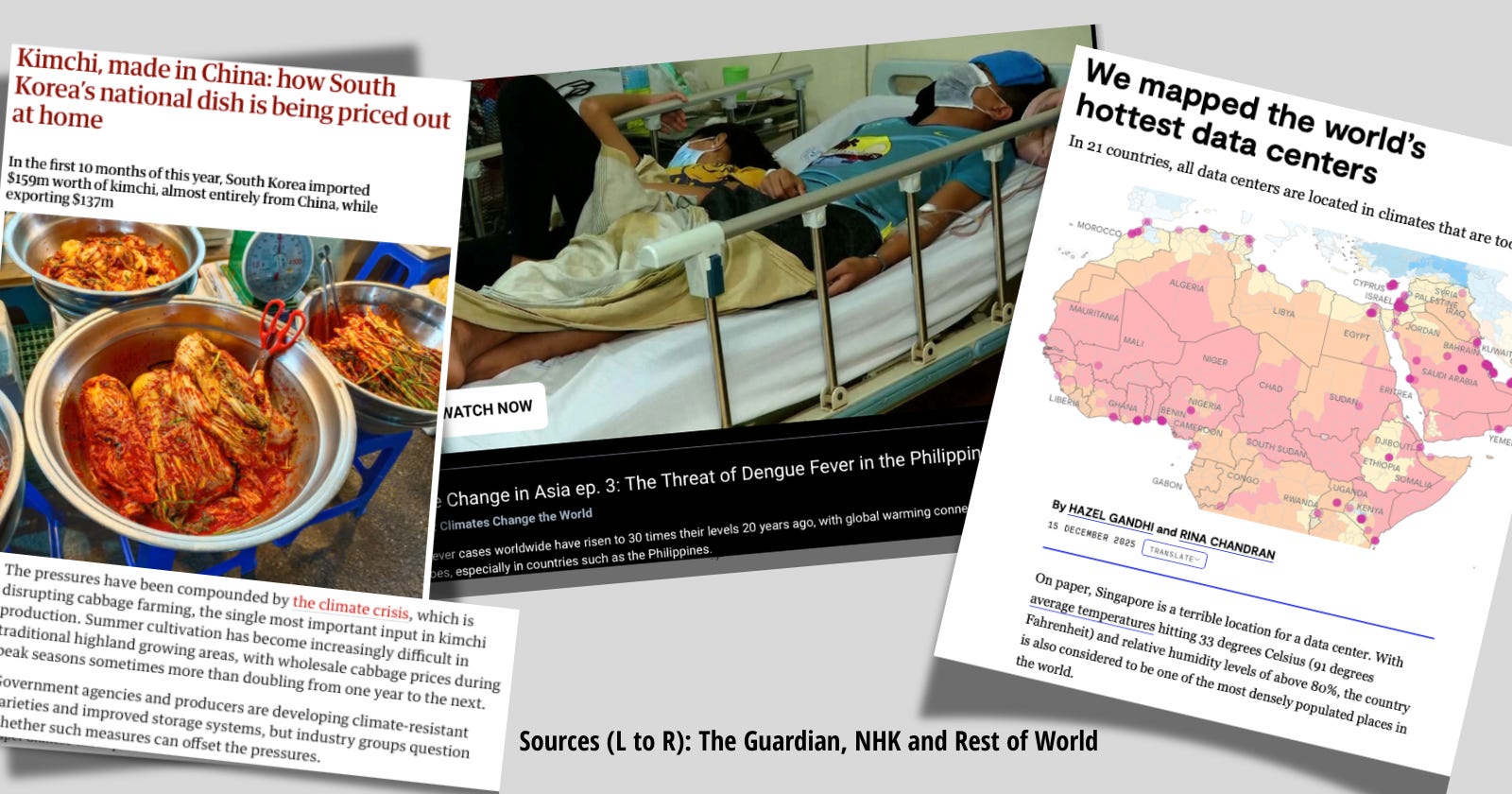
2 The climate is the biggest glocal story there is. It is for local journalists and media houses to dig into – and yes, make the planetary personal.
The climate breakdown is global and knows no borders, but is experienced locally and needs to be told locally as well – through examples and events, people’s voices and the things we care about. The climate is not only for the international media, wire agencies or ‘big’ media agencies to do.
You can also develop a local story by using the statistics and findings in a global report. You can inquire into how local advocates can make use of a landmark decision of global import – such as the unanimous International Court of Justice advisory opinion of July 2025 that says countries are legally obligated to curb greenhouse emissions – to demand accountability or more action.
Comparison with other communities and countries can add meaning to an event, statistic or discussion of a report’s findings.
Personal stories bring audiences closer. Take a look at how this story in The Guardian, ’Bhutan Mountain Man: video diaries from a local glaciologist’, pulls different strands together – the personal, the global, the scientific and the cultural (the myth of the Snow Lion at a time when Himalayan glaciers are melting rapidly).
Huge travel budgets are not always necessary. Coverage can be done from and about cities, which have been experiencing the impacts of extreme weather events, account for a large chunk of greenhouse gases. They are also venues for interesting initiatives toward living with a smaller carbon footprint.
3 Override the temptation to limit climate stories to disasters and ‘things that went wrong’, or think of climate news only in these contexts.
Disasters and debacles need to be reported, but bad news are far from the only ‘good’ stories worth telling. At this time of unease about the future, not to mention lack of information and/or understanding about the climate crisis, restricting climate-related stories to bad news can add to news fatigue and the feeling that there is little that people can do – or that what they do does not make a difference. Solid climate stories can be encouraging and light too.
Look for and report solutions and ideas for a decarbonized future – report the wins.
Sensible solutions do not need to be grand ones in order to merit attention by the news media, but they need to respond to developing-world realities. For instance, replacing GI-sheet roofing – often used in informal settlements and by outdoor vendors – with white-painted (and thus cooler) roof materials makes sense. Wouldn’t more trees planted by a city government or residents be life-saving when commuters are withering under 40C heat in urban heat islands?
Here are two examples of stories about what went right:
As the Philippines experienced more weather-related disasters, its underfunded Project NOAH (Nationwide Operational Assessment of Hazards), the country’s flagship disaster risk reduction and management programme, got new funding in 2026.
Vietnam’s ‘Thanh Nien’ reported that the Aeon Mall in central Hue province escaped the record flooding of November 2025 because its ground floor was 1.15 metres higher than street level. How did this happen? Flood survey data over the past 70 years was used in the building’s design.
4 Invest in doing enterprise journalism, which elevates climate-informed reportage and overall news quality.
Enterprise journalism involves reporting on what journalists and editors develop from what they observe, obtain or analyze, rather than press statements and press conferences.
When do you and your news outlet produce climate stories that came out of your own ideas? Don’t limit stories to those originating from press conferences, statements by activists, officials or politicians.
These are certainly useful for news and background. But aim to drive the news engine by generating stories from within your team, not just reacting to events designed for media attention and attendance.
5 Data, statistics and numbers are allies in storytelling - use them well. Visualizing them adds heft and depth to reporting, and helps draw audiences in.
There is an abundance of credible reports, dashboards and figures on a wide range of climate-related material. Some are global and regional, while others contain national-level data. They are produced by groups like international organisations and the United Nations, research institutes, universities, campaigners, insurance and risk management companies, respected scientists and climate experts as well as survey outfits.
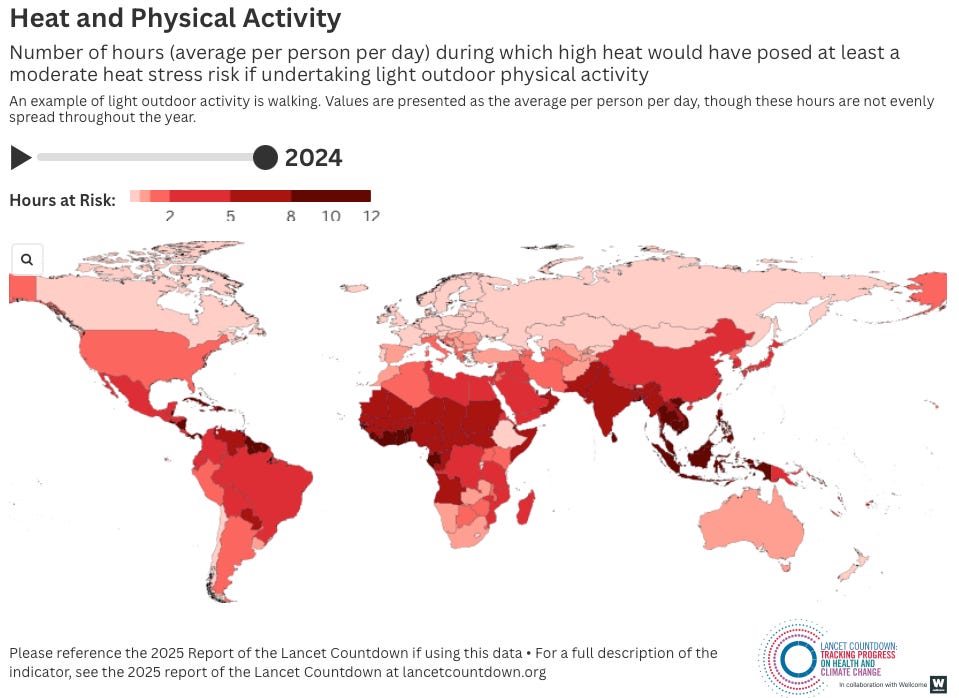
For example, the Lancet Countdown on Health and Climate Change data explorer is a goldmine of data. It has statistics about health and exposure to heatwaves all the way to tree loss. Journalists and desks can generate and download visuals with the specific data they want.
Climate Central allows journalists to use information such as how the temperature in one city compares with the average. Users can generate risk maps about sea-level rise in a location, including how global warming may affect this.
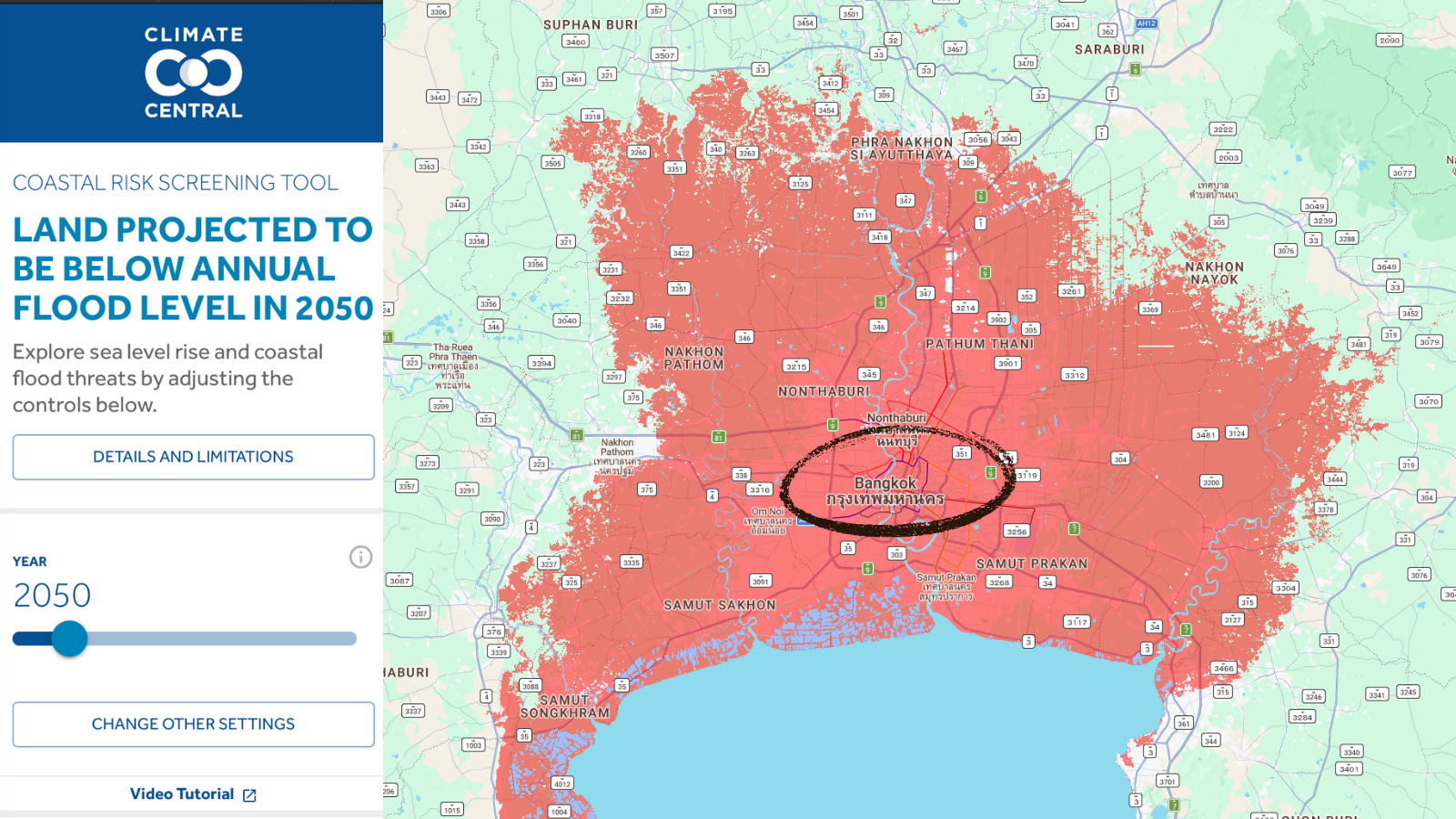
What’s the best part of having publicly available sources like these? You have credible data and statistics to use with your stories – even if your national ministry or officials don’t have them or don’t share them publicly.
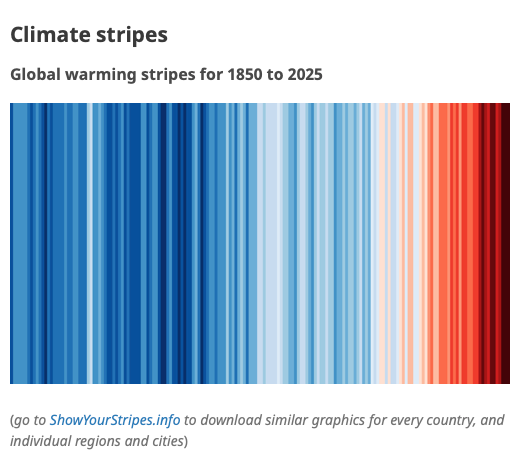
There are also good, ready-to-use visuals online. Check out #ShowYourStripes, which features warming stripes that can be used with a Creative Commons licence (CC By 4.0). The stripes, which go from shades of blue to red over time, are a at-one-glance way to convey how the world has warmed. Users can also select a city, country or region to generate the stripes for.
Developed by Ed Hawkins, professor of climate science at the UK-based University of Reading (his Substack is here), the warming stripes have been used in many ways around the world, projected onto buildings, cliffs and used in news articles and other materials.
Newsdesks can also explore the idea of making their own visuals. Might there be someone in your team who wants to do data journalism and data visualization? Is it feasible to set up a data section or desk?
Today’s data visualization platforms are meant for use by individuals, journalists included, without coding skills. Fluorish and Datawrapper are used by big and small newsrooms as well as individual storytellers. There are grants and other opportunities for training staff in data journalism.
As a sample, this Mekong Eye data story combines text and statistics to take readers on a trip exploring how the electric vehicle trend is pushing up demand for natural rubber in the Mekong region. (One in every five new cars sold today is electric. It is a clear sign of climate action, especially as electricity-run engines are much more efficient than internal combustion ones. But there are stories to tell around how to address the other impacts that come with the EV trend.)
6 Review, discuss – and update – the language of news around words, phrases and concepts relating to the climate crisis.
How the media talk about the climate helps shapes perceptions and everyday conversations.
Have you taken stock of how your news product explains climate matters in your stories? How about setting an editorial policy, including a style guide, that spells out to staff and copy editors how the climate is to be described consistently across stories? News managers can discuss the terms to use, making a choice, for instance, among the phrases ‘climate crisis’, ‘climate change’ and ‘climate breakdown’. (See also tip number 4 in ‘For News Managers and Editors’, or Part 5 of this newsletter series.)
Still using the phrase ‘natural disasters’ in stories? The ‘What’s in a Word?’ box (in Part 6 of this series) has tips for climate-related language in news.
7 Build relationships with credible climate scientists, disaster risk reduction experts as well as analysts who can be much more than interviewees in stories.
Trusted experts can be part of the a news team’s climate expertise and brand. They are potential collaborators, inside the newsroom or in more public-facing roles.
They may be able to come brief and help train news teams, or be sounding boards for story ideas and give feedback on how sound storylines are. Some experts have a knack for ‘translating’ government announcements and dense scientific findings into everyday language.
France Televisions, the French public television broadcaster that added the climate to its weather and other programming, has a segment where it shows audience questions about the weather or climate, and then gets experts to reply to these queries.
More data visualization on various aspects of the climate in Southeast Asia, done by Yvonne T Chua, are here.
See you next week. Part 3, ‘For Reporters and Story Producers’, comes out on 9 April 2026.
Johanna - founder/editor of the Reporting ASEAN series